

Writing an essay can feel like a challenge, especially if English is not your first language. But with the right approach, you can make your ideas clear and create essays that impress your teachers or readers. Essays are used in schools, universities, and even job applications.
Learning how to write a strong essay will help you in many parts of your life. In this article, you’ll learn easy steps, practical advice, and some expert secrets to write essays that are clear, logical, and powerful—no matter your English level.

36% off Today’s Exclusive Deals
Limited-time Exclusive Deals. Check current discount on Amazon.
Check Price on Amazon As an Amazon Associate I earn from qualifying purchases.Understanding What An Essay Is
An essay is a piece of writing where you share your thoughts, explain a topic, or argue a point. It usually follows a clear structure. Most essays have three main parts:
- Introduction: Where you tell the reader what your essay is about.
- Body: Where you explain your ideas in detail.
- Conclusion: Where you summarize your main points.
There are different types of essays, including argumentative, descriptive, narrative, and expository. Each serves a unique purpose. For example, argumentative essays try to persuade, while descriptive essays paint a picture with words.
Choosing The Right Essay Topic
Picking a good topic is the first important step. A strong topic makes your essay easier to write and more interesting to read. Here are some tips:
- Pick something you know: If possible, choose a topic you understand. It’s easier to explain ideas you are familiar with.
- Check requirements: Make sure your topic fits the instructions or assignment.
- Make it specific: Broad topics are hard to cover well. Narrow down your idea to something manageable.
For example, instead of writing about “technology,” focus on “how smartphones change the way people communicate. ”
Comparing Good Vs. Bad Essay Topics
Here’s a quick comparison to help you spot strong topics:
| Bad Topic | Good Topic |
|---|---|
| Pollution | The effects of air pollution on children in urban areas |
| Sports | Why teamwork is important in soccer |
| Education | How online learning changes student motivation |

Planning Your Essay: Outline And Structure
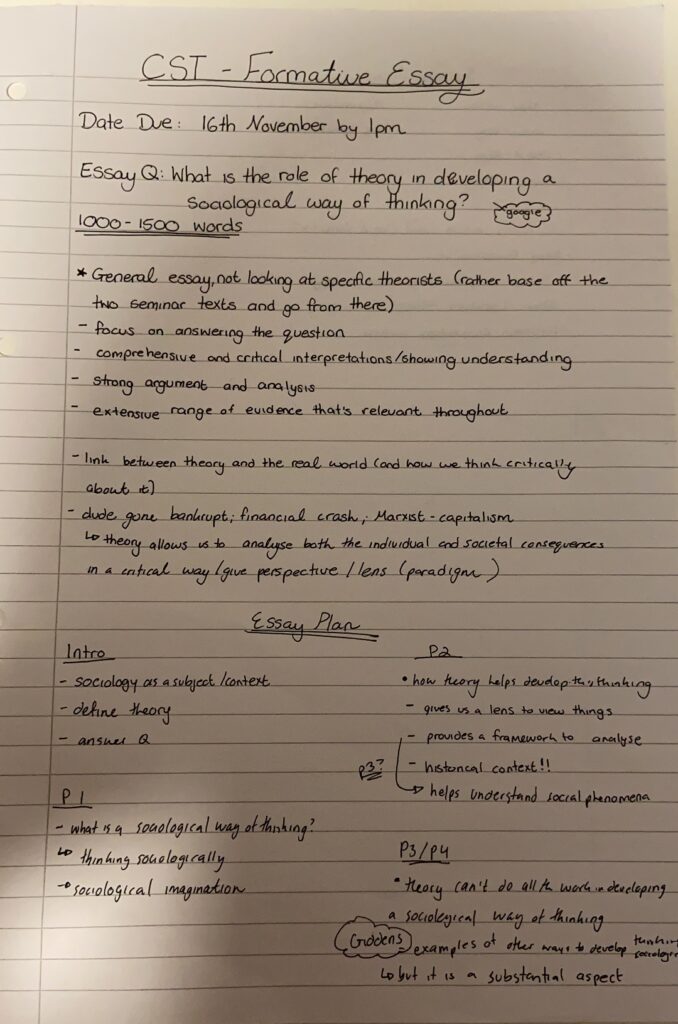
Before you start writing, plan your essay. A good outline helps you organize your thoughts and saves time.
Basic Essay Structure
Most essays follow this simple structure:
- Introduction
- Body Paragraph 1
- Body Paragraph 2
- Body Paragraph 3
- Conclusion
If your essay is longer, you can add more body paragraphs. Each paragraph should cover one main idea.
Creating An Outline
An outline is a list of what you will write in each section. Here is an example:
- Introduction: Present your topic and thesis statement.
- Body Paragraph 1: Explain your first idea and give examples.
- Body Paragraph 2: Discuss your second idea with evidence.
- Body Paragraph 3: Share your third idea and support it.
- Conclusion: Summarize your main points and restate your thesis.
Most students skip outlining, but it’s a mistake. Outlines make writing smoother and help you avoid repeating ideas.
Researching And Gathering Evidence
Strong essays use facts, statistics, and examples to support points. If your essay needs research, use reliable sources. Avoid copying from random blogs or social media.
Where To Find Reliable Information
- Academic journals
- Government websites
- Books
- News articles
For example, if you are writing about climate change, use data from the United Nations or NASA.
Citing Sources
Always give credit to the sources you use. This is called citing. Common citation styles are APA, MLA, and Chicago. Check your assignment for which style to use.
Here’s a simple citation example in APA style:
- (Smith, 2020)
If you don’t cite, you risk plagiarism—a serious academic problem.
Writing A Strong Introduction
Your introduction sets the tone. It should grab attention and tell the reader what to expect.
What To Include
- Hook: A sentence that catches interest (a question, quote, or fact).
- Background: Brief information about your topic.
- Thesis statement: A clear sentence showing your main point.
Example:
> Have you ever wondered why teamwork is so important in soccer? In today’s fast-paced games, players must work together to win. This essay will explain the key reasons why teamwork leads to success on the soccer field.
Your thesis should be clear and specific. Avoid vague statements.
Developing Body Paragraphs
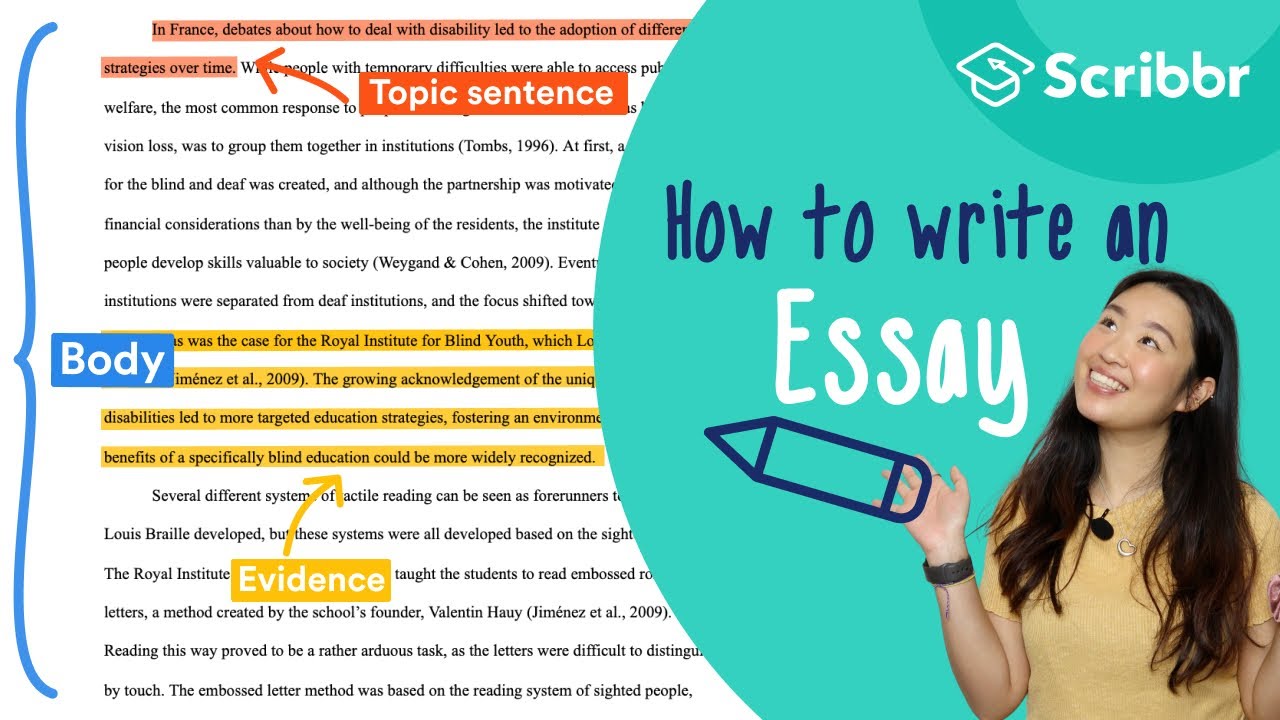
Each body paragraph should focus on one idea. Start with a topic sentence, add details, and finish with a short summary or transition.
Paragraph Structure
- Topic sentence: Main idea of the paragraph.
- Supporting details: Facts, examples, or statistics.
- Explanation: Show why your details matter.
- Concluding sentence: Wrap up or lead to the next paragraph.
Here is an example for an essay about online learning:
> Online learning increases flexibility for students. Many students can study at their own pace, which helps those with busy schedules. For example, a survey by the National Center for Education Statistics found that 67% of students prefer learning online because it fits their lives better. This flexibility is one reason online education is growing in popularity.
Using Evidence Effectively
- Choose facts that match your argument.
- Use numbers to make points stronger.
- Explain your evidence; don’t just list it.
Many students forget to explain their evidence. Always show how your facts support your idea.
Crafting A Powerful Conclusion
The conclusion is your final chance to impress the reader. It should summarize your main points and restate your thesis in a new way.
What Makes A Good Conclusion?
- Summarize main ideas: Briefly remind the reader what you discussed.
- Restate thesis: Use different words.
- End with a strong statement: Leave the reader thinking.
Example:
> In summary, teamwork is the foundation of success in soccer. By working together, players can achieve more than alone. As soccer continues to evolve, the value of teamwork will only grow.
Avoid new information in the conclusion. Just wrap up your essay.
Editing And Proofreading
Writing the essay is only half the job. Editing is where you fix mistakes and make your writing clearer.
Steps To Edit Your Essay
- Check grammar and spelling: Use tools like Grammarly or spell check.
- Read aloud: Hearing your essay helps find awkward sentences.
- Remove repetition: Don’t repeat ideas or words.
- Check your structure: Make sure each paragraph has one main idea.
- Get feedback: Ask a friend or teacher to review.
Many beginners skip editing, but it’s a mistake. Even small errors can weaken your essay.
Comparing Editing Tools
Here’s a quick comparison of popular editing tools:
| Tool | Features | Cost |
|---|---|---|
| Grammarly | Grammar, spelling, style | Free & Paid |
| Hemingway Editor | Readability, sentence structure | Free & Paid |
| Microsoft Word | Basic spelling and grammar | Paid |
Common Mistakes And How To Avoid Them
Many students make mistakes that are easy to fix. Here are some frequent problems:
- Ignoring the outline: Without planning, essays become messy.
- Weak thesis statement: If your thesis isn’t clear, your essay loses focus.
- Repetition: Don’t say the same thing in different ways.
- Lack of evidence: Always support your ideas with facts or examples.
- Poor grammar: Simple errors reduce your credibility.
Non-obvious Insights
- Transitions matter: Use words like “however,” “also,” “in addition,” to connect paragraphs. This makes your essay flow better.
- Paragraph length: Keep paragraphs balanced. Too short looks weak; too long loses focus.
Tips For Non-native English Writers
If English is not your first language, writing essays can be tough. Here are some practical tips:
- Use simple sentences: Short sentences are clearer and easier to control.
- Avoid slang: Use formal language for essays.
- Learn common linking words: Words like “because,” “although,” and “therefore” help your essay’s flow.
- Practice reading essays: Find examples online to see how others write.
Example Linking Words
| Function | Linking Words |
|---|---|
| Add ideas | Also, in addition, furthermore |
| Contrast | However, although, but |
| Cause/Effect | Because, therefore, as a result |
Using Data And Examples
Adding real data makes your essay stronger. For example, if you are writing about the importance of exercise:
> According to the World Health Organization, only 23% of adults get enough physical activity. This shows why promoting exercise is important.
Use examples from your life or news to make points clearer. If you don’t have data, use practical examples.
How To Write Different Types Of Essays
Argumentative Essays
These essays try to persuade. You need strong evidence and clear arguments.
Tips:
- Pick a side and stick to it.
- Use facts and statistics.
- Anticipate counterarguments (what opponents say).
Example Topic: “should Students Wear Uniforms?”
Descriptive Essays
These essays describe something—a place, person, or event.
Tips:
- Use sensory details (what you see, hear, feel).
- Paint a picture with words.
- Stay focused on one subject.
Example Topic: “describe Your Favorite Holiday.”
Narrative Essays
These essays tell a story. They are often personal.
Tips:
- Use first-person (“I”).
- Tell events in order.
- Show emotions and lessons learned.
Example Topic: “a Time You Overcame A Challenge.”
Expository Essays
These essays explain or inform. They are fact-based.
Tips:
- Stay objective (don’t show opinion).
- Use clear explanations.
- Break ideas into simple steps.
Example Topic: “how Photosynthesis Works.”
Using Quotations And Paraphrasing
Quotations can support your ideas, but don’t overuse them. Paraphrasing means rewriting information in your own words.
- Quote: Use exact words from a source. Example: “Education is the most powerful weapon” (Mandela, 1994).
- Paraphrase: Rewrite the idea. Example: Mandela believed education can change the world.
Always cite sources when you use quotes or paraphrases.
Time Management For Essay Writing
Writing an essay takes time. Here’s a smart way to manage your work:
- Plan: 10–15% of time
- Research: 20% of time
- Write: 40–50% of time
- Edit: 20% of time
If you have two days, spend a few hours planning and researching, then write, and leave enough time for editing.
Using Technology To Improve Your Essay
Modern tools can help you write better essays:
- Grammar checkers: Find grammar and spelling errors.
- Plagiarism checkers: Make sure your essay is original.
- Online dictionaries: Learn new words and their meanings.
For a deep guide on academic writing, you can visit the Purdue OWL website.
Practical Example: Step-by-step Essay Writing
Let’s walk through a sample essay writing process.
Example Topic: “why Is Reading Important?”
- Choose your topic: “Why is reading important?”
- Make an outline:
- Introduction: Hook, background, thesis.
- Body 1: Reading improves knowledge.
- Body 2: Reading develops language skills.
- Body 3: Reading boosts imagination.
- Conclusion: Summarize and restate thesis.
- Write the introduction:
> Imagine a world where nobody reads. Without books, knowledge stops growing. Reading is important because it builds knowledge, language skills, and imagination.
- Write body paragraphs: Each covers one point with facts and examples.
- Write the conclusion: Summarize and restate your thesis.
- Edit: Fix grammar, check structure, remove repetition.
By following these steps, your essay will be clear and convincing.
Frequently Asked Questions
How Long Should An Essay Be?
The length depends on your assignment. Most school essays are 300–800 words. College essays can be 1,000–2,000 words or more. Always check your instructions.
How Do I Make My Essay More Interesting?
Use examples, stories, and facts. Ask a question in your introduction. Use strong words and avoid repetition. Connect your ideas with transitions.
What Is A Thesis Statement?
A thesis statement is one sentence in your introduction that shows your main point. It guides your essay. Example: “Online learning is effective because it offers flexibility and cost savings.”
How Many Paragraphs Should My Essay Have?
Most essays have five paragraphs: one introduction, three body paragraphs, and one conclusion. Longer essays may have more body paragraphs.
Can I Use “i” In My Essay?
It depends on the essay type. Use “I” in narrative or personal essays. For argumentative or expository essays, avoid “I” and stay formal.
Writing an essay gets easier with practice. Start with simple steps, use clear language, and always plan before you write. With these tips, you can create essays that are strong, clear, and memorable—even if English is not your first language.
Remember, outlining and editing are as important as writing. Each essay is a chance to share your ideas and show your skills.

