

The foldable phone revolution has brought fresh energy to the smartphone market. At the same time, brands like Nothing are shaking things up with bold designs and software experiences. Two devices—the Motorola Razr+ and the much-anticipated Nothing Phone 3—are attracting a lot of attention for different reasons. One is a flip-style foldable with a classic name, while the other is an innovative slab phone pushing boundaries in design and interface. Choosing between them is not as simple as comparing specs. You need to consider how each fits your real-world needs, style, and expectations for a modern smartphone.
This article takes you through every angle of the Motorola Razr+ vs Nothing Phone 3 debate. We’ll look at their designs, displays, performance, software, cameras, battery life, and more. We’ll highlight unique details and insights so you can decide which device truly matches your life.

36% off Today’s Exclusive Deals
Limited-time Exclusive Deals. Check current discount on Amazon.
Check Price on Amazon As an Amazon Associate I earn from qualifying purchases.Let’s jump in.
Design And Build Quality
The design of a phone is more than just looks—it affects usability, durability, and even how you feel about the device in your hand.
Motorola Razr+: Classic Flip, Modern Twist
The Motorola Razr+ (called Razr 40 Ultra in some regions) is a foldable phone with a strong retro vibe. When closed, it fits easily in your palm or pocket. Flip it open, and you get a tall, modern OLED display.
- Materials: The Razr+ uses a mix of aluminum and Gorilla Glass Victus. The hinge feels solid and smooth. It’s not water-resistant, but it handles daily use well.
- Colors: Motorola offers bold choices like Viva Magenta alongside classic black and blue.
- Feel: Closed, it’s compact—similar in size to a makeup compact or small wallet.
- Weight and Thickness: About 188g and 15.1mm thick when closed, but only 7mm thick when open.
One detail many miss: the Razr+ hinge is engineered for over 400,000 folds. This is roughly 100 folds per day for 10 years—much more than most users will ever need. But it’s not dustproof, so keep it away from sand and lint.
Nothing Phone 3: The Transparent Statement
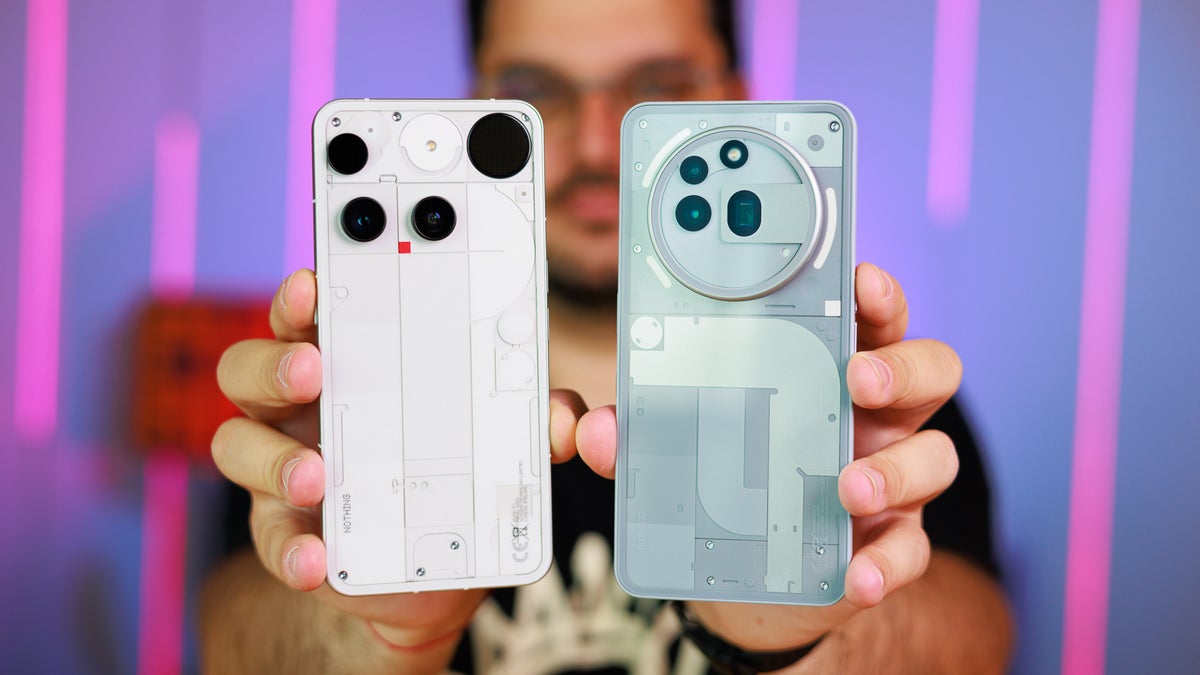
The Nothing Phone 3 continues the brand’s trend of see-through design and unique lighting elements (Glyph Interface). It isn’t a foldable, but it stands out even in a crowded market.
- Materials: Aluminum frame, Gorilla Glass front and back, with exposed screws and visible internals.
- Glyph Interface: LED strips on the back light up for notifications, charging, and custom patterns.
- Colors: Mainly black and white, but with the special transparent effect.
- Weight and Thickness: Expected at around 195g and 8.3mm thick.
A non-obvious insight: the transparent design isn’t just about style. It helps with cooling, and the LEDs can indicate things like battery level or call status at a glance—no need to turn the phone over.
Head-to-head: Design Comparison
Here’s a quick side-by-side look at the core design specs:
| Feature | Motorola Razr+ | Nothing Phone 3 |
|---|---|---|
| Form Factor | Foldable flip | Flat slab |
| Materials | Aluminum, Glass | Aluminum, Glass |
| Weight | 188g | 195g (est.) |
| Thickness | 7mm (open), 15.1mm (closed) | 8.3mm |
| Special Features | Foldable, large cover screen | Glyph Interface, transparent back |
Real-world tip: If pocket space matters, the Razr+ is unbeatable. If you want to stand out or love customizing notifications, the Nothing Phone 3’s Glyph interface gives you that edge.
Display: Foldable Flexibility Vs Flat Brilliance
A phone’s display affects everything from watching videos to reading text. Both these phones approach the display experience differently.
Motorola Razr+: Dual Displays, Ultimate Flexibility
The Razr+ is famous for its two displays:
- Main Screen: 6.9-inch pOLED, 2640×1080, 165Hz refresh rate, HDR10+ support.
- Cover Display: 3.6-inch pOLED, 1066×1056, 144Hz, supports full apps and widgets.
The high refresh rate (165Hz) makes scrolling and animations extra smooth. The cover display is not just for notifications—you can reply to messages, run apps, and even use it as a camera viewfinder.
A surprising detail: you can put the phone in “tent mode” or “half-fold” for video calls, hands-free selfies, or media playback. The cover screen also doubles as a mini gaming console—great for quick play without opening the device.
Nothing Phone 3: Flat, Fluid, And Bright
The Nothing Phone 3 is rumored to use a 6.7-inch AMOLED display, 120Hz refresh rate, with a flat panel and very thin bezels. Expect:
- Resolution: Likely 2400×1080, sharp and clear.
- Brightness: Around 1600 nits peak, ideal for outdoor use.
- Flat Design: No curved edges, which means fewer accidental touches.
A key insight: the flat display is less prone to scratches at the edges, and the uniform bezels make the phone feel more balanced in the hand.
Display Comparison Table
Let’s compare the displays directly:
| Feature | Motorola Razr+ | Nothing Phone 3 |
|---|---|---|
| Main Display Size | 6.9-inch (foldable) | 6.7-inch |
| Refresh Rate | 165Hz | 120Hz |
| Peak Brightness | 1400 nits | 1600 nits (est.) |
| Secondary Display | 3.6-inch cover screen | None |
| Unique Features | Half-fold mode, full app support on cover | Glyph lighting notifications |
What most people miss: The Razr+ cover screen can save you time—checking messages or snapping selfies without opening the phone. The Nothing Phone 3’s Glyph interface, while not a display, also gives instant info without lighting up the whole screen.
Performance And Hardware
How fast a phone feels comes down to the processor, RAM, storage, and thermal design.
Motorola Razr+: Flagship-level, Foldable-optimized
The Razr+ is powered by the Snapdragon 8+ Gen 1 chip. It’s not the absolute newest, but it’s still very fast and efficient.
- RAM: 8GB or 12GB LPDDR5
- Storage: 256GB UFS 3.1 (no SD card slot)
- 5G Support: Yes (sub-6GHz and mmWave, depending on region)
You can run demanding games, edit videos, or multitask with ease. The phone stays cool thanks to Motorola’s custom cooling solution, but heavy gaming can warm up the hinge area.
A less-known fact: Motorola tunes the Razr+ to use less power when folded or using the cover screen, which means better real-world battery life than many expect.
Nothing Phone 3: Efficiency Meets Style
The Nothing Phone 3 is expected to use a Snapdragon 8s Gen 3 or similar, which is a balance between flagship speed and battery life.
- RAM: 8GB/12GB/16GB options
- Storage: 128GB/256GB/512GB (no SD card)
- 5G Support: Yes, all global bands
The Nothing Phone 3’s software is optimized for speed and smoothness, so even with a slightly less powerful chip, it feels fast in day-to-day tasks.
A practical insight: Nothing’s software tweaks (like minimal animations) make the phone feel quicker, even if the chip is technically a step below the latest Snapdragon.
Hardware Features: What Matters Most?
- Speakers: Both offer stereo speakers, but the Nothing Phone 3 is expected to have slightly louder, clearer sound.
- Haptics: Nothing phones are known for precise, satisfying vibration feedback.
- Biometrics: Both use fast under-display fingerprint sensors.
Expert tip: Unless you play the most demanding mobile games, both phones are more than fast enough for everyday use. Focus on storage needs and RAM if you keep lots of apps open or store many photos/videos.
Software Experience
The software can make or break a phone. Both Motorola and Nothing offer their own take on Android.
Motorola Razr+: Clean Android With Foldable Extras
The Razr+ runs near-stock Android with Motorola’s MyUX skin. It’s clean, light, and free of bloatware.
- Special Features: Moto Gestures (quick launch camera, flashlight chop), cover screen widgets, split-screen multitasking on the main display.
- Updates: Promised 2 years of Android OS updates and 3 years of security patches.
A subtle advantage: Motorola’s cover screen UI is more customizable than many expect. You can add almost any app, not just Motorola’s own widgets.
Nothing Phone 3: Nothing Os And Glyph Integration
Nothing’s Nothing OS is as close to stock Android as you’ll find, with a few clever twists.
- Glyph Composer: Customize how the back LEDs flash for different contacts or apps.
- No Bloat: Very few pre-installed apps, and those that are there feel purposeful.
- OS Updates: Promised 3 years of Android updates, 4 years of security patches.
A unique detail: Nothing OS is one of the few that offers system-wide monochrome and retro themes, giving you a different look from typical Android phones.
Software Table
Compare side-by-side:
| Feature | Motorola Razr+ | Nothing Phone 3 |
|---|---|---|
| OS Version | Android 13 (at launch) | Android 14 (at launch) |
| Update Policy | 2 years OS, 3 years security | 3 years OS, 4 years security |
| Unique Features | Cover screen UI, Moto Gestures | Glyph Composer, retro themes |
| Bloatware | Minimal | None |
What beginners often miss: OS support matters. The Nothing Phone 3 will stay current longer, which means better security and features over time.
Cameras: Versatility Vs Simplicity
Cameras are one of the most important features for many users. Let’s see how these two phones compare.
Motorola Razr+: Cover Screen Selfies And Flex Mode
- Main Camera: 12MP f/1.5 wide with OIS
- Ultra-Wide: 13MP f/2.2 with macro support
- Front Camera: 32MP punch-hole (mainly used for video calls)
The main advantage: you can use the main cameras for selfies (thanks to the cover display) for much better quality. You can also put the phone in half-fold mode for hands-free group shots.
A detail many miss: The Razr+’s camera is tuned for fast capture and good skin tones, but it’s not as good in low-light as some slab phones.
Nothing Phone 3: Dual Cameras, Ai Tricks
- Main Camera: 50MP f/1.8 wide with OIS
- Ultra-Wide: 50MP f/2.2 (rumored)
- Front Camera: 32MP
The Nothing Phone 3 puts a lot of focus on computational photography. Features like Motion Capture, Night Mode, and glyph-assisted fill light (using the LEDs as a soft flash) help in tricky situations.
A less obvious insight: The Nothing Phone 3’s camera app allows for RAW capture and pro controls, appealing to photography fans.
Camera Comparison: What Matters
- Daylight Shots: Both do well, but the Nothing Phone 3’s higher resolution sensors give more detail.
- Low Light: Nothing Phone 3 is expected to have the edge, thanks to software and hardware.
- Selfies: Razr+ wins for flexibility—you can use the main camera for selfies with the cover screen as a viewfinder.
- Video: Both support 4K at 60fps, but the Razr+ is easier to use hands-free in tent/half-fold mode.
Pro tip: If you take lots of group selfies or creative shots, the Razr+’s form factor opens new possibilities. If you want the most detail in every shot, the Nothing Phone 3’s 50MP sensor is hard to beat.
Battery Life And Charging
Battery size doesn’t tell the whole story—efficiency, charging speed, and real-world use matter too.
Motorola Razr+: Clever Battery Use
- Battery Size: 3800mAh
- Charging: 30W wired, 5W wireless
The Razr+ battery sounds small, but using the cover screen for quick tasks saves power. Most users get a full day with normal use, but power users or heavy gamers will need a top-up by evening.
A practical detail: The smaller battery helps keep the phone light and thin, but you’ll want to carry a charger if you’re traveling.
Nothing Phone 3: Bigger Battery, Faster Charging
- Battery Size: 4700mAh (rumored)
- Charging: 45W wired, 15W wireless, 5W reverse wireless
The Nothing Phone 3’s bigger battery and more efficient chip mean you can expect over a day of heavy use. Fast charging gets you from 0 to 100% in under 50 minutes.
A beginner often misses: Nothing’s reverse wireless charging lets you top up earbuds or a friend’s phone on the go.
Battery Table
Quick glance:
| Feature | Motorola Razr+ | Nothing Phone 3 |
|---|---|---|
| Battery Size | 3800mAh | 4700mAh (est.) |
| Wired Charging | 30W | 45W |
| Wireless Charging | 5W | 15W |
| Reverse Wireless | No | Yes |
Real-life advice: If you travel often or forget to charge, the Nothing Phone 3 is more forgiving. If you mostly use your phone for calls, messages, and social media, the Razr+ is fine—especially with cover screen use.
Connectivity And Extras
Both phones are 5G-ready and packed with modern features, but there are some differences.
- SIM: Both support eSIM and physical SIM, but the Razr+ often has dual SIM only in specific regions.
- Wi-Fi: Both support Wi-Fi 6E for faster speeds.
- Bluetooth: Razr+ has Bluetooth 5.3; Nothing Phone 3 will likely have Bluetooth 5.4.
- NFC: Both support Google Pay/contactless payments.
- Audio: Neither has a headphone jack. Both support high-res audio over Bluetooth.
- Water Resistance: Both have basic splash resistance, but neither is fully waterproof.
A key insight: The Razr+ is more vulnerable to dust due to the hinge, so it’s less ideal for construction sites or dusty environments.
Price And Value
Pricing can change based on region, storage, and deals, but here’s a general idea:
- Motorola Razr+: Launched at $999 (US), but often available for less.
- Nothing Phone 3: Expected launch price around $599–$699, depending on storage.
The Razr+ costs more due to its foldable display and engineering. The Nothing Phone 3 offers strong specs and design at a lower price.
A beginner mistake: Choosing only by price. The Razr+ offers a unique experience that may be worth the extra cost if you value compactness and the flip design.

Who Should Choose Which?
Here’s some straight-to-the-point guidance:
Choose the Motorola Razr+ if you:
- Want a truly compact phone that fits small pockets or bags.
- Like the nostalgia and fun of a flip phone.
- Take lots of selfies or group photos and want the main camera for them.
- Appreciate hands-free video calls and creative camera angles.
Choose the Nothing Phone 3 if you:
- Want a bold, modern look that stands out.
- Prefer a big, flat display for gaming, reading, or movies.
- Care about long battery life and fast charging.
- Want more years of software updates and better night photography.
Unique Use Cases And Real-world Scenarios
For Commuters: The Razr+ is perfect if you want to quickly check messages on the subway or bus—just glance at the cover screen. The Nothing Phone 3’s Glyph can notify you silently without vibrating or making noise.
For Creators: Both are strong, but the Razr+’s flexible hinge lets you shoot hands-free, while the Nothing Phone 3’s RAW capture and pro controls help with editing.
For Gamers: The Razr+’s 165Hz screen is smoother, but the Nothing Phone 3’s flat display and stereo sound are better for long sessions.
For Minimalists: The Nothing Phone 3’s OS is cleaner, with fewer pre-installed apps, and the Glyph interface can help you avoid picking up your phone unnecessarily.
Potential Downsides
No phone is perfect. Here’s what you should know:
- Motorola Razr+: Screen crease is visible at some angles. The battery is just okay, not great. Not as durable as a slab phone if dropped.
- Nothing Phone 3: No cover display or foldable fun. The Glyph interface, while cool, is not useful to everyone. Camera bump is slightly raised, which could wobble on tables.
Tip: Consider a case for both phones to improve grip and protect from scratches. For the Razr+, a case can help keep dust out of the hinge.
Long-term Support And Brand Reliability
Motorola has a long history, but its update policy is sometimes shorter than rivals. Nothing is a newer brand, but has promised longer updates and is more active in the community.
Fact: Motorola has improved its foldable support, but Nothing’s active forums and regular updates make it feel more “alive” for enthusiasts.
Which Is Best For You?
The decision depends on what you value most:
- Innovation and nostalgia: Razr+
- Battery and software updates: Nothing Phone 3
- Flexible camera use: Razr+
- Unique notifications and design: Nothing Phone 3
If you’re looking for the latest foldable tech and love the feel of a flip phone, the Razr+ is hard to match. If you want a stylish, modern, reliable device with a long support window, the Nothing Phone 3 is a great bet.
To dive deeper into the specs and stay updated on both devices, you can check the official Motorola Razr+ page.
Frequently Asked Questions
Is The Motorola Razr+ More Durable Than The Nothing Phone 3?
The Nothing Phone 3 is more durable in terms of drops and dust resistance, since it uses a standard slab design with no moving parts. The Motorola Razr+ hinge is rated for years of use, but foldables can be more vulnerable to dust and accidental damage. Use a protective case for both to reduce risk.
Which Phone Is Better For Photography?
The Nothing Phone 3 offers higher resolution sensors and stronger low-light performance, plus pro controls and RAW capture. The Razr+ wins for selfies, as you can use the main camera with the cover screen as a viewfinder, offering higher quality front-facing shots.
Does The Glyph Interface On The Nothing Phone 3 Drain Battery?
The Glyph LEDs are designed to use very little power. They only light up when needed (for notifications, charging, etc.), so they have a minimal impact on daily battery life. You can also turn them off or customize their behavior.
Can I Use Both Phones With Any Carrier?
Both the Motorola Razr+ and Nothing Phone 3 are unlocked and support most global 5G and 4G bands, but it’s important to check specific bands for your country and carrier before buying. Some features like eSIM or mmWave 5G may depend on region.
Which Phone Will Get More Software Updates?
The Nothing Phone 3 is expected to get longer support—3 years of Android OS updates and 4 years of security patches. The Motorola Razr+ offers 2 years of OS updates and 3 years of security. If long-term software is important, the Nothing Phone 3 is the safer choice.
In the end, both the Motorola Razr+ and the Nothing Phone 3 offer something truly different in a sea of lookalike phones. Your best choice comes down to your priorities: do you want nostalgia and a folding experience, or do you want bold new design and reliable performance for years to come? Either way, you’ll be holding one of the most interesting phones on the market today.


