

A standard badminton court is 13.40 m long and 6.10 m wide for doubles (5.18 m for singles).
I’ve measured, marked, and played on courts at clubs and schools, so I know the details that matter. This article explains the dimensions of a badminton court in clear, practical terms, covers singles versus doubles differences, net height, service lines, surface needs, and how to mark a court yourself. Read on for exact numbers, easy diagrams you can picture, and tips from hands-on experience to help you set up or evaluate any court.

36% off Today’s Exclusive Deals
Limited-time Exclusive Deals. Check current discount on Amazon.
Check Price on Amazon As an Amazon Associate I earn from qualifying purchases.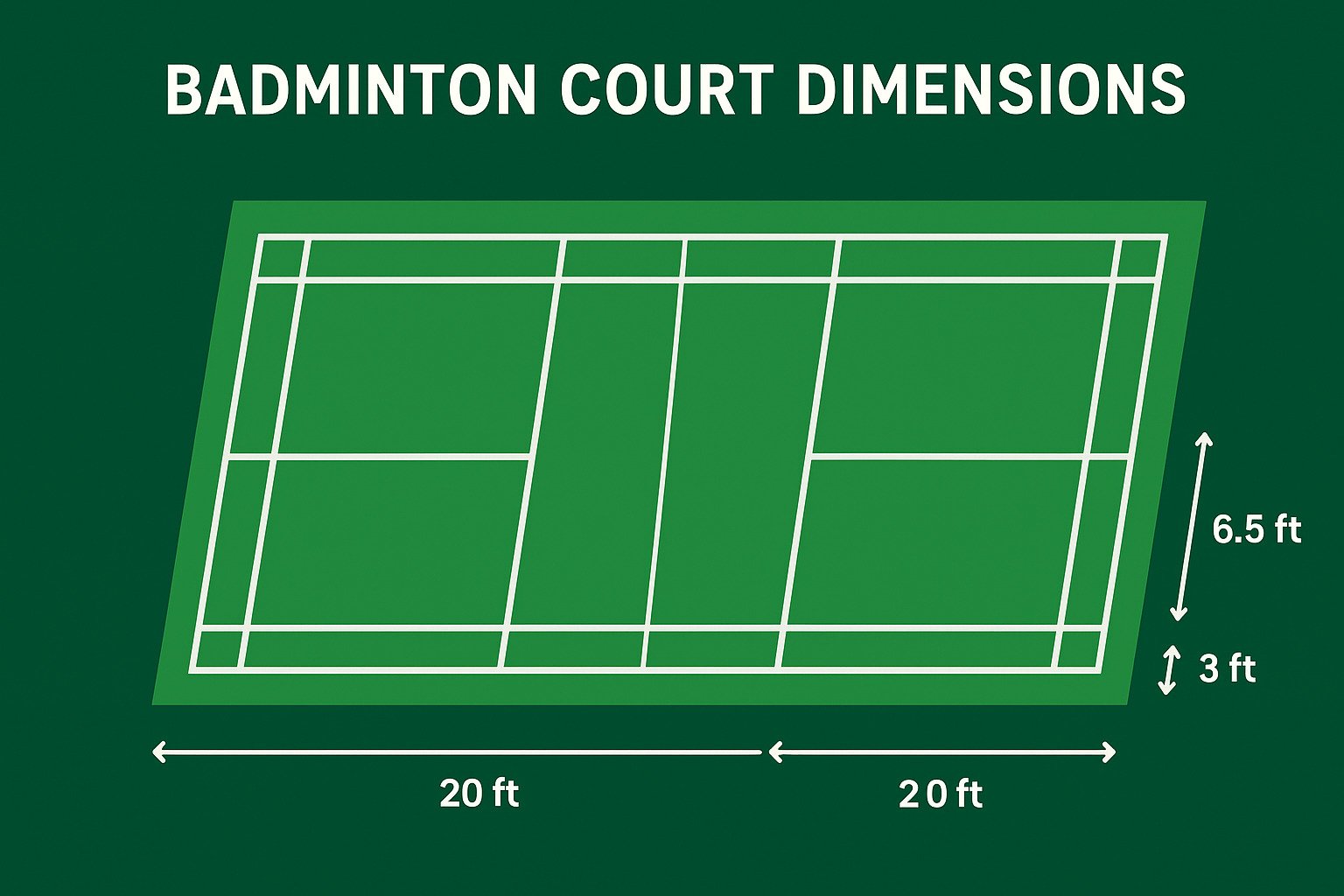
Official dimensions and overall layout
A regulation badminton court is a rectangle. The official dimensions of a badminton court are simple to remember once you see them side by side.
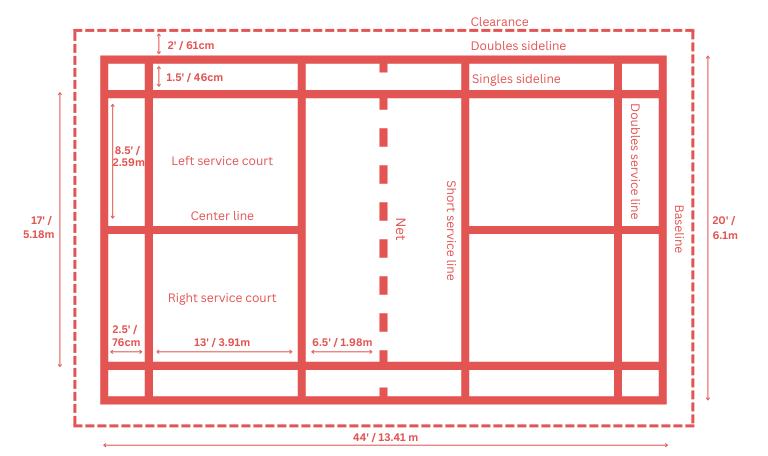
- Court length: 13.40 meters (44 feet).
- Court width for doubles: 6.10 meters (20 feet).
- Court width for singles: 5.18 meters (17 feet).
- Half-court from net to baseline: 6.70 meters (22 feet).
Think of the court as one long rectangle with different side lines used for singles and doubles. The perimeter lines mark doubles play. The inner sidelines mark singles play. Saying the dimensions of a badminton court aloud helps: 13.40 m by 6.10 m for doubles, 13.40 m by 5.18 m for singles.
Singles versus doubles — what changes
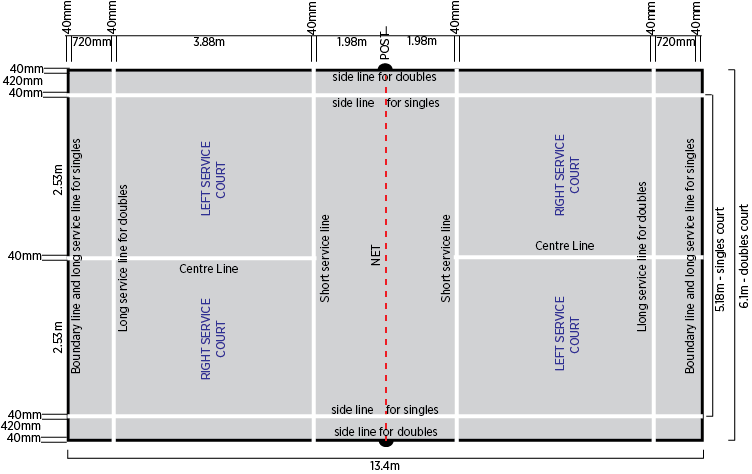
The main differences in the dimensions of a badminton court between singles and doubles are the width and the location of the long service line for doubles.
- Doubles uses the full width of 6.10 m. Singles uses the narrower 5.18 m width.
- Service area differs: for doubles, the long service line is 0.76 meters (2 ft 6 in) in from the back boundary. For singles, the back boundary is the long service line.
- The short service line is the same for both: 1.98 meters (6 ft 6 in) from the net.
These small changes affect play and strategy. When coaching or setting lines, always mark both sets so players know whether they're in singles or doubles mode.
Net height, posts, and placement
Net height is critical in the court’s specifications. The dimensions of a badminton court include clear net standards.
- Net height at center: 1.524 meters (5 feet).
- Net height at posts: 1.55 meters (about 5 feet 1 inch).
- Posts are placed on the doubles sidelines for tournament play. For casual play, posts are often placed to suit the equipment.
A tight, level net helps fair play. I once tightened a sagging net before a club match; it changed the feel of rallies immediately. If you’re setting up, measure the net height at the center and on the posts.
Lines, service courts, and key measurements
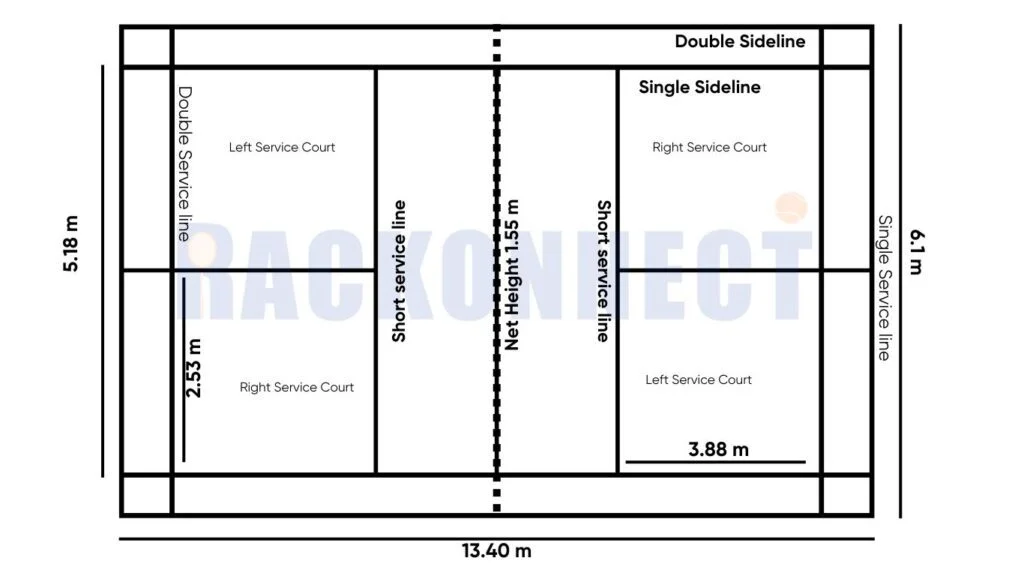
To understand the dimensions of a badminton court, know the line names and where they sit.
- Short service line: 1.98 meters from the net.
- Centre line: divides left and right service courts from the short service line to the long service line.
- Back boundary: the baseline at the rear edge of the court.
- Long service line for doubles: 0.76 meters from the back boundary toward the net.
- Boundary lines are typically 40 mm wide (a standard in many competitions).
These lines define valid play areas and service boxes. Clear, contrasting paint or tape makes the court easy to read under lights.

Court surface, clearances, and environment
The dimensions of a badminton court are fixed, but the space around the court matters for safety and performance.
- Recommended clearance: at least 2 meters of free space on all sides for recreational play.
- Competition clearance: larger arenas use 3 meters or more behind baselines and at least 2 meters at sides.
- Overhead clearance: high enough to allow clear lobs; many halls aim for 7 to 9 meters for competitive play.
- Flooring: synthetic mats or sprung wooden floors give the best grip and shock absorption.
I’ve played in gyms with poor side clearances. It makes players hesitant near the lines. If you plan matches, prioritize extra room behind baselines.

How to measure and mark a court — practical DIY steps
If you need to mark a court, follow these simple steps I used when lining a school hall.
- Measure the baseline first
- Mark a straight line 13.40 meters.
- Use a chalk line or laser for accuracy.
- Find the centre and mark the net line
- Measure 6.70 meters from the baseline to the net line on each end.
- Ensure the net line is parallel to the baseline.
- Mark sidelines for doubles and singles
- Mark the outer sidelines at 6.10 meters wide.
- Mark inner singles sidelines at 5.18 meters wide, centered.
- Add service lines
- Short service line: 1.98 meters from net on both sides.
- Long doubles service line: 0.76 meters in from back boundary.
- Paint or tape lines 40 mm wide for visibility
Tools I recommend: tape measure (at least 30 m), chalk line, painter’s tape or court marking paint, string, and a helper to keep measurements square. Common mistakes: not checking squareness, uneven line widths, and poor lighting when marking.

Common measurement questions (PAA-style)
How wide is a singles court?
A singles court is 5.18 meters (17 feet) wide. The length remains 13.40 meters.
How far from the net is the short service line?
The short service line is 1.98 meters (6 ft 6 in) from the net on both sides.
Where are posts placed for official matches?
Posts are usually placed on the doubles sidelines and set to hold the net 1.55 m at the posts, with the center at 1.524 m.

Frequently Asked Questions of What are the dimensions of a badminton court?
What is the official length of a badminton court?
The official length is 13.40 meters (44 feet) for both singles and doubles. All other lines are measured from this baseline.
What is the width difference between singles and doubles?
Doubles width is 6.10 meters (20 feet). Singles width is 5.18 meters (17 feet), narrower by 0.92 meters.
How high should the net be?
The net height is 1.524 meters at the center. At the posts the net is slightly higher, commonly set at 1.55 meters.
How far back is the short service line?
The short service line sits 1.98 meters from the net on each side. It marks the front of the service box.
Where is the long service line for doubles?
The long service line for doubles is 0.76 meters in from the back boundary. For singles, the back boundary itself is the long service line.
Are line widths standardized?
Yes. Lines are typically 40 millimeters wide. Consistent widths help judges and players see the court clearly.
Do indoor and outdoor courts use the same dimensions?
Yes, the dimensions of a badminton court are the same whether indoors or outdoors. Outdoor play may differ due to wind and surface.
How much space is needed around a court for safe play?
Allow at least 2 meters of free space around the court for casual play. Competition venues often give more, especially behind baselines.
Can I place posts on the singles sidelines?
For casual play you can place posts on singles sidelines to create a standard net tension for singles. Official tournaments position posts on the doubles sidelines.
What is the best floor for a badminton court?
A sprung wooden floor or professional synthetic mat provides the best shock absorption and grip. Avoid hard, slippery surfaces.
Conclusion
Knowing the precise dimensions of a badminton court makes set up, coaching, and play clearer and fairer. The court is 13.40 meters long, 6.10 meters wide for doubles, and 5.18 meters wide for singles, with specific service and net measures that shape the game. Use the simple measuring steps and tips above to mark a reliable court or to check a venue before playing. Try it yourself: measure once, mark carefully, and you’ll enjoy safer, more accurate play. If this guide helped, leave a comment, share your court-marking story, or subscribe for more practical sports setup tips.

