

Connect the manifold to the low and high service ports, open valves, and read pressures safely.
I’ve worked on HVAC systems for years and will walk you through exactly how do you connect an AC gauge to an air conditioner? This guide covers safety, tools, step-by-step hookup, reading interpretation, common mistakes, and real-world tips so you can do the job right and with confidence. Read on to learn practical steps and avoid the pitfalls I’ve seen on service calls.

36% off Today’s Exclusive Deals
Limited-time Exclusive Deals. Check current discount on Amazon.
Check Price on Amazon As an Amazon Associate I earn from qualifying purchases.
Tools, parts, and safety you need before starting
Before you connect the AC gauge to an air conditioner, gather the right tools. Work without the right items can damage the system or cause injury.
-
Tools and parts to have
- AC manifold gauge set with low (blue) and high (red) ports.
- Three hoses: blue (low), red (high), and yellow (service/recharge).
- Appropriate adapters for R-410A or R-22 if needed.
- Safety glasses and gloves.
- Refrigerant scale when charging.
- Thermometer or infrared gun to measure temperature.
- Leak detector and sniffer for safety checks.
-
Safety checks
- Turn off the air conditioner at the thermostat and breaker before connecting.
- Confirm refrigerant type on the unit label; gauges and adapters must match.
- Avoid breathing refrigerant or venting it to the atmosphere.
- Use gloves and glasses; refrigerant can cause frostbite on contact.
From experience, forgetting a scale or adapter is common and slows the job. Double-check tools before you start.

Understanding AC gauges and basic pressure concepts
An AC gauge measures pressures on both sides of the system. Knowing what the numbers mean helps diagnose issues.
-
What each gauge shows
- Low-side gauge (blue): suction pressure from the evaporator.
- High-side gauge (red): discharge pressure from the compressor.
- Center port on the manifold: service port for vacuum, charging, or recovery.
-
Why pressures matter
- Pressures link to temperatures and refrigerant state.
- Low pressure too low can mean low refrigerant or a restriction.
- High pressure too high may indicate overcharge, airflow problems, or a dirty condenser.
If you’re asking "How do you connect an AC gauge to an air conditioner?" understanding these basics first makes the hookup clearer and faster.

How do you connect an AC gauge to an air conditioner? Step-by-step procedure
Follow these steps slowly and clearly. This is the core answer to How do you connect an AC gauge to an air conditioner?
-
Prepare the system
- Turn off power at the breaker and set the thermostat to off.
- Verify refrigerant type on the outdoor unit label.
- Remove caps from both low and high service ports.
-
Inspect the manifold and hoses
- Check hoses for cracks and the manifold valves for smooth operation.
- Ensure the center yellow hose valve is closed if attached to a refrigerant bottle or vacuum pump.
-
Attach hoses to manifold
- Connect the blue hose to the manifold low-side port.
- Connect the red hose to the manifold high-side port.
- Connect the yellow hose to the middle manifold port for service.
-
Hook manifold to the unit
- Screw the blue hose quick-connect to the low-side service port (larger diameter on many systems).
- Screw the red hose quick-connect to the high-side service port (smaller diameter on many systems).
- Tighten by hand and give a quarter turn with pliers if needed; do not overtighten.
-
Power the air conditioner and open valves
- Restore power and put the system in cooling mode on full load.
- Open the low-side valve on the manifold first, then the high-side, slowly.
- Watch the gauges stabilize before drawing conclusions.
-
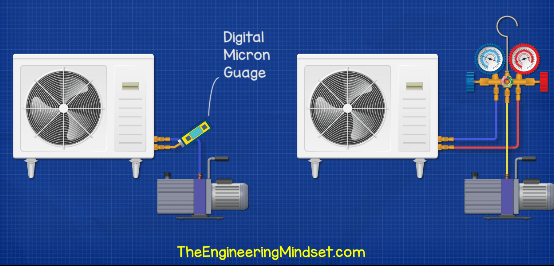
Use the center port as needed
- For vacuum: attach the yellow hose to a vacuum pump, open both manifold valves, and pull vacuum.
- For charging: attach the yellow hose to the refrigerant bottle (upright for gas charging or inverted for liquid per refrigerant rules), then open the service valves carefully while monitoring the scale.
-
Finish and disconnect
- Close manifold valves before disconnecting hoses.
- Recover or charge refrigerant according to regulations.
- Replace port caps and restore normal settings.
When you repeat the steps to answer How do you connect an AC gauge to an air conditioner?, remember to work methodically. Rushing often causes leaks or misreads.

Interpreting gauge readings and next steps
After you connect an AC gauge to an air conditioner, readings tell the story. Learn to read them and decide what to do.
-
Typical reading patterns
- Normal cooling operation: low-side will show a pressure that corresponds to evaporator temperature; high-side will match condensing temperature.
- Low low-side pressure: possible low refrigerant, blocked capillary or TXV issue, or collapsed evaporator coil.
- High high-side pressure: poor condenser airflow, overcharge, or stuck compressor valves.
-
Convert pressure to temperature
- Use pressure-temperature charts for the system refrigerant.
- Compare measured suction temperature and calculated saturation temperature to find superheat or subcooling.
-
Practical next steps
- Low refrigerant diagnosis: check for leaks, repair, and then recharge by weight.
- Airflow issues: clean or replace air filters and inspect the condenser coil.
- Mechanical faults: refer complex compressor or valve issues to a qualified technician.
If your question is "How do you connect an AC gauge to an air conditioner?" then knowing reading interpretation completes the diagnostic loop.
Quick user questions (PAA-style)
How do you connect an AC gauge to an air conditioner without leaking?
- Use hand-tight connections, inspect O-rings, and open valves slowly while watching for pressure changes.
How do you connect an AC gauge to an air conditioner for charging?
- Attach hoses, connect the yellow hose to the refrigerant bottle or scale, and add refrigerant by weight while monitoring pressures and temperatures.
How do you connect an AC gauge to an air conditioner safely?
- Turn off power, wear PPE, verify refrigerant type, and never vent refrigerant to atmosphere.

Common mistakes and troubleshooting tips
Knowing common mistakes helps you avoid them when you connect an AC gauge to an air conditioner.
-
Frequent errors
- Hooking to the wrong port or mixing low and high lines.
- Forgetting to close the center hose valve before disconnecting.
- Charging by gauge pressure alone without weighing refrigerant.
-
Troubleshooting quick tips
- If gauges don’t move: check for closed service valve or clogged hose.
- If readings swing wildly: check for loose connections, hose leaks, or a failing compressor.
- If vacuum won’t hold: inspect for leaks or open valves.
From my own service work, the most costly error was charging by gauges only. Always use a scale and check manufacturer specs.

Maintenance, calibration, and storage of your gauge set
Keep your gauges accurate and ready by following simple maintenance steps. Proper care matters every time you connect an AC gauge to an air conditioner.
-
Calibration
- Have gauges calibrated annually or if they drop accuracy.
- Check zero reading with both valves closed; low-side should read zero.
-
Storage
- Keep hoses clean and caps on ports.
- Store gauges in a dry, padded case to avoid drops.
-
Longevity tips
- Replace cracked hoses and worn fittings.
- Don’t leave hoses connected to a pressurized system when not in use.

Frequently Asked Questions of How do you connect an AC gauge to an air conditioner?
What hoses connect to which ports when you connect an AC gauge to an air conditioner?
Connect the blue hose to the low-side port and the red hose to the high-side port. The yellow hose goes to the manifold center for vacuum, recovery, or charging.
Can I connect an AC gauge to an air conditioner while the system is off?
You can connect the hoses while the system is off, but open valves and power the unit only when ready to take readings or perform service. Always ensure safety and correct refrigerant type first.
How do I avoid refrigerant leaks when connecting an AC gauge to an air conditioner?
Inspect hose fittings and O-rings, tighten by hand plus a small turn, and open valves slowly. Use a sniffer to check for leaks after connecting.
Is it safe to charge refrigerant after you connect an AC gauge to an air conditioner?
Charging is safe if you follow manufacturer specs, use a scale, and match refrigerant type. Incorrect charging can harm the unit or violate local regulations.
Do I need special adapters to connect an AC gauge to an air conditioner?
Some systems, especially R-410A, require specific adapters or fittings. Check the unit label and gauge compatibility before connecting.
Conclusion
You now have a clear, step-by-step path for how do you connect an AC gauge to an air conditioner? Start with the right tools, practice safe hookups, read pressures accurately, and avoid common mistakes like charging without a scale. My experience shows that patience and preparation make the biggest difference on service calls. Try these steps on your next job, keep learning, and leave a note below if you want a checklist or troubleshooting flowchart to guide each service.

