

Singles focus on court coverage and endurance; doubles prioritize teamwork, speed, and sharp net play.
I’ve coached and played both formats for years, so I know the subtle and clear ways the difference between singles and doubles badminton shapes everything from training to tactics. In this guide I break down rules, court use, skills, fitness, strategy, and practical tips to help players move between formats or choose which fits them best.

36% off Today’s Exclusive Deals
Limited-time Exclusive Deals. Check current discount on Amazon.
Check Price on Amazon As an Amazon Associate I earn from qualifying purchases.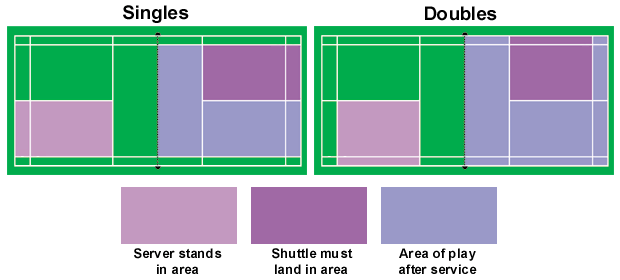
What exactly defines singles and doubles badminton?
Singles and doubles are the two main game formats in badminton. The core difference between singles and doubles badminton lies in players per side and how court space and roles are used. Singles is one player per side on a slightly narrower court. Doubles is two players per side and uses the full court width, which changes serving lines and tactical choices. Both formats use the 21-point rally scoring system, but tactics and positioning differ a lot.

Court layout, service rules, and scoring
Court and service lines change how you play. The difference between singles and doubles badminton starts with court boundaries. Singles play uses the long and narrow court. Doubles uses the full width, including the side alleys, but has a slightly shorter serve length for the first service.
Key points
- Court area: Singles excludes side alleys; doubles includes alleys for rallies.
- Serve area: Doubles uses the short service line on returns, making serves tighter and quicker.
- Scoring: Both use the best-of-three to 21 rally point scoring. Let calls and faults are the same.
Why this matters
- In singles you cover more length and must fetch lobs and deep clears.
- In doubles you must cover width and trust your partner to cover gaps.

Strategy and tactics: how play changes
Strategy shows the clearest difference between singles and doubles badminton. Singles players focus on creating angles, moving the opponent, and controlling the backcourt. Doubles players emphasize quick exchanges, front-back and side-by-side formations, and setting up winners fast.
Common formations and roles
- Attack formation in doubles: Front player controls net; back player attacks with smashes and drives.
- Defensive formation in doubles: Side-by-side to block drives and cover smashes.
- Singles strategy: Use clears, drops, and net play to exploit space and tire the opponent.
Tactical tips
- Hit precise serves and returns in doubles to force weak attacks.
- In singles, mix pace and vary depth to create openings.
Personal note: I often tell students to treat doubles like a chess match where tempo is king. I learned that a single weak midcourt return in doubles costs points fast. The difference between singles and doubles badminton shows up in how much you trust your partner and how you build points.
PAA-style questions
Can a singles player succeed in doubles?
- Yes. A singles player with good court coverage and stamina can succeed, but they must learn teamwork and fast net exchanges.
Is doubles faster than singles?
- Doubles feels faster due to rapid exchanges and compact rallies. Singles requires more sustained movement.

Skills and technique differences
Technical focus changes by format. The difference between singles and doubles badminton is obvious when you compare shot emphasis.
Shot focus by format
- Singles: Deep clears, tight net drops, angled drives, and accurate smashes from midcourt.
- Doubles: Fast drives, flat exchanges, explosive smashes, tight net kills, and quick drives.
Serve and return
- Singles: Longer serves and tactical short-deep mix.
- Doubles: Short low serves to limit attack; flick serves to surprise.
Net play
- Doubles net play is aggressive and decisive. Singles net play is a tool to set up backcourt winners.
Practice drills
- Singles drill: Multi-directional endurance drills and long rally control.
- Doubles drill: Short court reflex drills, drive exchanges, and attack-defense rotations.

Physical and conditioning demands
Fitness is different for each format. The difference between singles and doubles badminton is clear in conditioning needs.
Singles demands
- High aerobic endurance for long rallies.
- Strong recovery between rallies and sustained movement.
Doubles demands
- Explosive power, speed, and fast recovery for short intense rallies.
- Quick lateral movement and reflexes.
Training tips
- For singles, add interval runs and long rally simulations.
- For doubles, add short sprints, plyometrics, and reaction drills.
Personal experience: Switching from singles to doubles, I had to cut longer runs and add short explosive work. My foot speed and volley reflex improved quickly.

Equipment and minor rule differences that matter
Rules are mostly the same, but preferences vary. The difference between singles and doubles badminton affects racket choice and shuttle behavior.
Equipment and setup
- Racket: Doubles players often prefer slightly stiffer frames and lower string tension for faster response. Singles players may favor higher tension for control and power.
- Shuttle: Same shuttle is used, but doubles rallies may heat the shuttle faster, altering flight.
Rule nuances
- No rule changes in scoring system between formats.
- Service faults and lets follow the same rulebook, but doubles service boundaries differ for short serves.
Common mistakes, drills, and practical tips
Mistakes to avoid show the practical difference between singles and doubles badminton. Learn from these common errors.
Common mistakes
- Singles players in doubles: trying to cover everything and not trusting partner.
- Doubles players in singles: relying on partner positioning and standing too close to the center.
Drills and practice
- Shadow drills for positioning and rotation in doubles.
- Endurance rally drills and targeted drop/clear practice in singles.
- Partner communication exercises to build nonverbal cues and rotation habits.
Quick actionable tips
- Communicate with short calls like “mine” or “back” in doubles.
- Practice consistent deep clears and short drops for singles control.
- Record practice matches and review positioning and shot selection.
Personal tip: When I coach beginners, I emphasize one simple rule—move as a unit in doubles, and make your opponent move in singles. That shifts mindset fast and improves match play.
Frequently Asked Questions of What is the difference between singles and doubles badminton?
What is the main difference between singles and doubles badminton?
The main difference is one player versus two players per side, which changes court use, positioning, and tactics. Singles focuses on covering length and creating angles, while doubles focuses on teamwork, speed, and net control.
Are the rules and scoring the same for both?
Yes. Both formats use the 21-point rally scoring system and most rules. Service boundaries and short service lines differ for doubles serves.
Which format is better for fitness?
Singles is better for building endurance and long-court stamina. Doubles develops explosive speed, reflexes, and short-burst fitness.
Can skills from singles help in doubles and vice versa?
Yes. Singles builds footwork and control, which help doubles. Doubles improves reflexes and drive skills that help singles net play.
How long does it take to switch effectively from singles to doubles?
It varies, but with focused practice on positioning and communication, players can adapt in weeks. Mastery of quick net exchanges and rotation takes longer.
Conclusion
Singles and doubles are two sides of the same sport, each rewarding different strengths. Singles tests endurance, precision, and solo tactics. Doubles tests teamwork, speed, and split-second coordination. Use the difference between singles and doubles badminton to guide your practice and match choices. Try both formats to learn new skills, then focus on drills that match your goals.
Takeaway: Pick the format that fits your strengths, then train specifically for its demands. Share your experiences, ask questions, or subscribe for more practical badminton guides.

