

Reading faster is a skill that can change your life. Imagine finishing books in days instead of weeks, or tackling work reports in minutes rather than hours. Speed reading is not just about racing through pages; it’s about understanding and remembering information quickly.
Whether you are a student, a professional, or just someone who wants to read more for fun, learning how to read faster can help you save time and be more productive.

36% off Today’s Exclusive Deals
Limited-time Exclusive Deals. Check current discount on Amazon.
Check Price on Amazon As an Amazon Associate I earn from qualifying purchases.But speed reading is not magic. There are real methods, practical exercises, and smart habits behind it. In this article, you’ll learn step-by-step how to read faster, without losing comprehension. You’ll also discover common mistakes, tools that help, and how to measure your progress.
Plus, you’ll see how the world’s fastest readers do it, and how you can start improving today—even if English is not your first language.
The Science Behind Speed Reading
Reading is more than just seeing words. It involves your eyes, your brain, and sometimes even your mouth. Most people read at about 200–250 words per minute (wpm), which is normal for silent reading. But some people can read over 1000 wpm with good understanding. How do they do it?
One important thing to know is that your eyes and brain work together when you read. Your eyes move across the line, stopping and starting many times. Your brain takes in the information, tries to understand it, and sometimes even fills in missing details without you noticing.
This is why you can sometimes read quickly and still “get” the meaning, even if you don’t focus on every word.
How Your Eyes Move
When you read, your eyes don’t move smoothly across the page. Instead, they jump from word to word in short movements called saccades. After each jump, your eyes pause for a split second, called a fixation. Reading faster means making shorter fixations, fewer jumps, and covering more words in each look.
Most people make about 7–9 fixations per line of text. With practice, you can reduce that to 3–4 fixations per line. This means your eyes will move more efficiently, and you’ll read whole phrases instead of just single words. For example, instead of reading “the cat sat on the mat” as six words, your eyes can learn to see it as two groups: “the cat sat” and “on the mat.” This is a big reason why speed readers can move through text so quickly.
Subvocalization
Most people silently say words in their head as they read. This is called subvocalization. It slows you down because you read at the speed you speak, which is much slower than your brain can process. Speed readers learn to reduce subvocalization and let their brains process words visually.
Some people don’t realize how much subvocalization controls their speed. If you try to listen to an audiobook at 2x speed, you’ll notice your brain can actually follow along. This shows that your mind can handle information much faster than your speaking voice.
Reducing subvocalization is not about stopping it completely (which is nearly impossible), but about letting your eyes and brain work together more efficiently. You can try to notice when you are “saying” every word in your mind and gently remind yourself to focus on meaning instead.
Comprehension Vs Speed
Reading faster only helps if you still understand what you read. Studies show that comprehension drops if you go too fast. The goal is to balance speed and understanding. For most people, increasing speed to 400–600 wpm is possible without losing comprehension.
A useful example is reading for exams. If you read your study notes too quickly, you might miss key facts. But if you read too slowly, you may not finish all the material. The sweet spot is when you’re reading fast enough to cover everything, but still able to remember and use the information later.
Practice helps you find this balance.
Practical Techniques To Read Faster
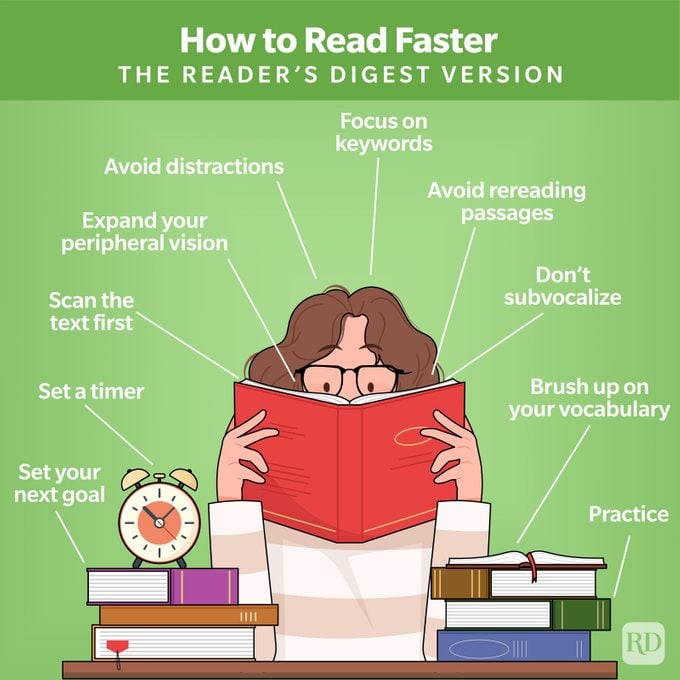
You don’t need special equipment to read faster—just a few simple techniques and regular practice. Here are the most effective methods.
1. Use A Pointer
Move your finger, a pen, or a pointer under the line you’re reading. This guides your eyes and keeps your focus. It also reduces unnecessary jumps and fixations.
This method works because your eyes naturally follow movement. If you notice your eyes often “lose their place” or you reread lines by mistake, using a pointer can solve this problem. For beginners, a finger works well. As you get faster, you can switch to a pen or simply imagine a line guiding your eyes.
Try moving your pointer a little faster than your normal reading speed; your eyes will try to keep up, and you’ll naturally read faster.
2. Expand Your Vision
Instead of reading word by word, train your eyes to see groups of words. Your eyes can cover about 1.5 inches of text at once, which is 3–4 words. Practice reading chunks instead of single words.
At first, this might feel strange, but it gets easier. Try to relax your eyes and let them “soft focus” so you see more of the line at once. You can practice with wide columns of text, or even write out lines yourself, spacing out the words.
Over time, your brain will start to recognize patterns and phrases instead of just letters or single words.
A good exercise is to draw vertical lines on a page, dividing the text into three sections. Try to read one section at a time with each glance, instead of moving your eyes across every single word. This will train you to process more information with each eye movement.
3. Reduce Subvocalization
Try humming or listening to instrumental music while reading. This distracts your inner voice. You can also count silently as you read, focusing on the meaning instead of pronouncing each word.
Some people find it helpful to tap their fingers or chew gum, as it keeps the mouth busy and less likely to “say” each word. Remember, you don’t want to ignore meaning. If you feel lost, slow down and refocus.
Reducing subvocalization takes time, but even a small reduction will help you read faster.
4. Preview Before Reading
Skim headlines, bold text, and summaries before you start. This gives you context and helps your brain process information faster. When you know what to expect, you read with purpose.
For example, before reading a long article, glance at the headings, photos, and first sentences of each paragraph. This “map” prepares your mind to pick out key information and ignore less important details. You’ll notice you remember more, even when reading quickly.
5. Practice Daily
Speed reading is like exercise. Practice for 15–20 minutes a day. Use articles, e-books, or even social media posts. Challenge yourself to increase speed while keeping your understanding high.
Try setting a timer and seeing how much you can read in five minutes. Keep a notebook where you write down key points from what you read. This helps you check your comprehension and track your improvement. Remember, small, regular practice is better than trying to do a lot at once and getting tired.
Measuring Your Reading Speed
Knowing your current reading speed is important. It helps you set goals and track progress.
To calculate your words per minute:
- Choose a page with about 250–300 words.
- Set a timer for one minute.
- Read normally and count how many words you finished.
- Repeat and average your results.
Here’s a comparison of reading speeds:
| Speed (wpm) | Reader Type | Comprehension Level |
|---|---|---|
| 200–250 | Average adult | High |
| 400–600 | Trained reader | High |
| 1000+ | Speed reader | Moderate |
| 2000+ | World record | Low |
Most people can double their speed with practice, but comprehension is key. If you understand less, slow down.
Another way to check comprehension is to summarize what you read. After each page, write down the main idea in your own words. If you cannot do this, you may be reading too fast. This simple test helps you find your best speed.
Avoiding Common Mistakes
Many beginners make mistakes when trying to read faster. Here are some to watch out for:
- Reading too fast: If you rush, you miss important details.
- Skipping practice: Speed reading needs regular training.
- Ignoring comprehension: Understanding is more important than speed.
- Not adjusting for content: Technical or complex texts need slower reading.
- Sticking to old habits: Using the same old reading methods won’t help.
One non-obvious insight: Sometimes, reading slower is better. For deep learning or complex topics, it’s OK to slow down. Speed reading is not for every situation.
Another mistake is comparing yourself to others. Everyone has a different best speed. Focus on your own progress. Also, don’t measure speed only once. Your mood, energy, and interest affect reading speed. Track your speed at different times to see your real average.

Choosing The Right Materials
Not all texts are suitable for speed reading. Simple news articles, emails, and fiction books are easy to read quickly. But scientific papers, law documents, and poetry require more attention.
Here’s a comparison:
| Text Type | Recommended Speed (wpm) | Reason |
|---|---|---|
| Fiction novels | 400–600 | Simple language |
| News articles | 300–500 | Short paragraphs |
| Scientific papers | 150–250 | Complex terms |
| Legal texts | 100–200 | Precise details |
| Poetry | 50–100 | Emotional meaning |
Be flexible. Adjust your speed based on what you’re reading.
If you find a text too difficult, slow down and reread. For easier texts, push your speed and see how much you understand. Over time, even complex texts will become easier as your vocabulary and confidence grow.
Tools And Apps For Speed Reading
Technology can help you practice and improve your reading speed. There are apps, browser extensions, and websites designed for speed reading.
Some popular tools:
- Spreeder: Lets you paste text and shows words quickly on the screen.
- ReadSpeeder: Helps you train your eye to see word groups.
- Acceleread: Offers guided lessons for increasing speed.
- BeeLine Reader: Uses color gradients to guide your eyes.
Many of these tools are free or have trial versions. Try a few and see which one works best for you.
Another useful tool is the “Read Later” function in browsers or apps like Pocket. Save interesting articles and practice speed reading with them. Some apps even track your progress and suggest new exercises. Remember, technology should support your practice, not replace real reading.
Speed Reading Vs Deep Reading
Speed reading is great for getting information fast. But sometimes, deep reading is better. Deep reading means slowing down to analyze, reflect, and remember details.
Here’s a quick comparison:
| Speed Reading | Deep Reading |
|---|---|
| Fast, surface-level | Slow, detailed |
| Skims for main ideas | Reads for full understanding |
| Uses word groups | Focuses on each word |
| Good for emails, news | Good for textbooks, poetry |
For most tasks, a mix of both is best. Use speed reading to preview and deep reading for important sections.
A helpful example: When studying, speed read a chapter first to get the main ideas, then deep read the most important parts. This combination saves time and improves memory.
Real-life Examples And Success Stories
Many famous people use speed reading. John F. Kennedy was known for reading 1200 wpm. Bill Gates reads one book per week. Professional speed readers can finish novels in one hour.
In studies, students who learned speed reading improved their scores by 10–15% in exams, because they could review more material. In business, fast readers process emails and reports quicker, saving hours each week.
A non-obvious insight: You can use speed reading for language learning. If English is not your first language, practice reading simple texts quickly. This helps your brain adapt to new words and structures.
Some people use speed reading to stay updated with news, read research papers, or enjoy more novels. Even if you don’t become a world champion, improving your speed by just 20–30% makes a big difference over time. If you read 10 books a year now, you could finish 13–14 books with the same effort, simply by reading a bit faster.
Tips For Non-native English Readers
If English is not your first language, speed reading can be challenging. But with the right approach, you can improve quickly.
- Start with easy texts: Use children’s books, simple news, or graded readers.
- Look up unknown words: But don’t stop for every word. Guess meaning from context.
- Practice reading aloud: This helps with pronunciation and speed.
- Use translation apps: But only when necessary.
- Join reading groups: Sharing with others boosts motivation and understanding.
One more tip: focus on phrases, not single words. English often uses phrases that don’t translate word-for-word. Speed reading helps you see these as units, improving both speed and understanding. Also, reread favorite texts. The second time, you’ll read much faster and with more confidence.
Remember, reading speed will increase as you become more comfortable with the language. Don’t worry if you need to slow down sometimes.
Building Long-term Habits
Speed reading is not a one-time skill. It needs regular practice and good habits.
- Set daily goals: For example, read 10 pages every day.
- Track your progress: Use a journal or app.
- Reward yourself: Celebrate when you reach milestones.
- Mix materials: Read different types of texts.
- Stay patient: Improvement comes with time.
Try sharing your progress with friends or online groups. Teaching others what you learn can also deepen your understanding. If you find yourself losing motivation, remind yourself why you want to read faster—maybe to learn new skills, follow your hobbies, or succeed in your job.
Many people quit because they expect instant results. But speed reading is like learning to play an instrument. Practice, patience, and the right techniques make all the difference.

Frequently Asked Questions
How Can I Improve My Reading Speed Quickly?
To boost reading speed fast, use a pointer, expand your vision to see word groups, and practice daily. Start with easy texts and increase difficulty slowly. Avoid saying each word in your head. Regular practice makes a big difference.
Is Speed Reading Possible For Everyone?
Most people can learn to read faster with training. But not everyone can reach extreme speeds like 2000 wpm. Aim for a realistic goal, such as doubling your current speed. Remember, comprehension matters more than speed.
Does Speed Reading Reduce Comprehension?
If you go too fast, understanding drops. The best speed is where you can still remember what you read. For most people, 400–600 wpm is a good target. Test yourself by summarizing texts after reading.
Are Speed Reading Apps Effective?
Many apps help train your eyes and brain to read faster. Tools like Spreeder or BeeLine Reader guide you and offer practice exercises. Use them along with traditional reading for best results. For more information, visit Scientific American.
What Is The World Record For Speed Reading?
The fastest readers claim speeds over 4000 wpm, but with low comprehension. The average trained speed reader can reach 1000–1200 wpm with moderate understanding. For most people, doubling your current speed is a realistic and useful goal.
Speed reading is a valuable skill that can help you in school, work, and life. It is not about rushing, but about reading smartly. With daily practice, the right tools, and a focus on understanding, anyone can learn to read faster.
Start today, track your progress, and enjoy the benefits of efficient reading.

