

Starter motor troubleshooting symptoms often show as clicking, grinding, slow cranking, or complete no-start.
I’ve spent more than a decade diagnosing and fixing starting systems. This guide explains Starter Motor Troubleshooting Symptoms clearly, with step-by-step checks, real tips, and plain language so you can find the problem faster and decide whether to repair or replace the starter.

36% off Today’s Exclusive Deals
Limited-time Exclusive Deals. Check current discount on Amazon.
Check Price on Amazon As an Amazon Associate I earn from qualifying purchases.
Common Starter Motor Troubleshooting Symptoms
Starter Motor Troubleshooting Symptoms are usually easy to notice. They tell you if the starter, battery, or related parts are at fault.
- Clicking when you turn the key. This often means the starter solenoid is trying to engage but not getting enough power.
- Grinding noise. This can mean worn starter teeth or a bad engagement with the flywheel.
- Slow cranking. The engine turns slowly. This points to low battery voltage, poor connections, or internal starter drag.
- No crank, no click. The starter gets nothing or the solenoid fails. It may be a dead battery, a bad ignition switch, or a failed starter.
- Intermittent starts. The car starts sometimes and not others. This suggests loose wires, failing solenoid, or heat-related starter failure.
- Smoke or burning smell. Overheating or an electrical short in the starter. Stop and inspect immediately.

What causes these Starter Motor Troubleshooting Symptoms?
Knowing causes helps you pick the right test and fix. Many problems mimic starter failure but have other roots.
- Weak battery. Low voltage is the top cause of slow cranks and clicking.
- Corroded or loose battery terminals. Poor contact limits current to the starter.
- Faulty starter solenoid. The solenoid controls the heavy current to the motor. If it fails, the starter won’t engage.
- Worn starter drive gear. Teeth wear or a slipped gear causes grinding.
- Bad starter bearings or armature. Internal wear causes drag and slow cranking.
- Poor ground. A bad chassis ground raises resistance and cuts starter power.
- Faulty ignition switch or wiring. No signal can reach the starter.
- Heat soak. Starters near hot engine parts can fail intermittently after the car sits hot.

How to diagnose Starter Motor Troubleshooting Symptoms step-by-step
A clear sequence reduces guessing. Use basic tools: multimeter, wrench, jumper cables, and a helper for some tests.
- Basic safety
- Put the car in park or neutral and set the parking brake. Wear eye protection.
- Check battery voltage
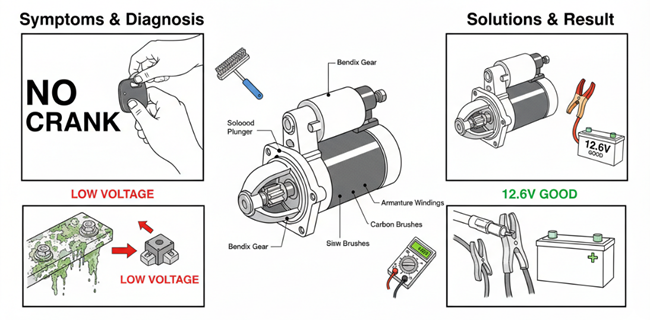
- Measure battery voltage with the key off. Healthy battery reads about 12.6 V. Less than 12.2 V needs charging or replacement.
- Try a jump start
- If jump-starting fixes the issue, the problem is likely the battery or charging system, not the starter.
- Inspect battery terminals and ground
- Clean corrosion. Tighten clamps. Check the ground strap between engine and chassis.
- Listen for sounds
- Clicking suggests low power or a bad solenoid. Grinding suggests mechanical wear. No sound suggests wiring or ignition switch issues.
- Voltage at starter while cranking
- Have a helper crank the engine while you measure voltage at the starter input. If voltage drops below ~9.6 V under load, the battery, connections, or cables are weak.
- Voltage drop test
- Measure voltage drop from battery positive to starter terminal while cranking. More than 0.5 V indicates high resistance.
- Tap test
- Lightly tap the starter while someone cranks. If it sometimes works after a tap, the starter brushes or solenoid may be failing.
- Bench test or remove starter
- If tests point to the starter, remove it and bench-test with a jumper and battery to observe behavior.
- Check related parts
- Test alternator output. A bad alternator causes repeated battery drain that mimics starter failure.

Fixes and when to replace the starter
Not every issue needs a new starter. Match the fix to the diagnosis.
- Clean and tighten terminals
- Corrosion and loose clamps cause many false alarms. This fix is cheap and fast.
- Replace battery or cables
- If voltage is low or cables show high resistance, replace them first.
- Repair or replace solenoid
- Some starters allow solenoid replacement separately. It depends on model and cost.
- Replace starter drive gear or rebuild starter
- Grinding and internal wear usually require starter rebuild or full replacement.
- Replace starter assembly
- Replace when bench tests show internal failure or when cost of repair approaches replacement cost.
- Professional repair
- If you find damaged flywheel teeth or complex electrical faults, consult a mechanic.
When to replace:
- Repeated intermittent failures after tests point to internal wear.
- Bench test failure under proper voltage.
- Damaged housing, burned windings, or seized motor.
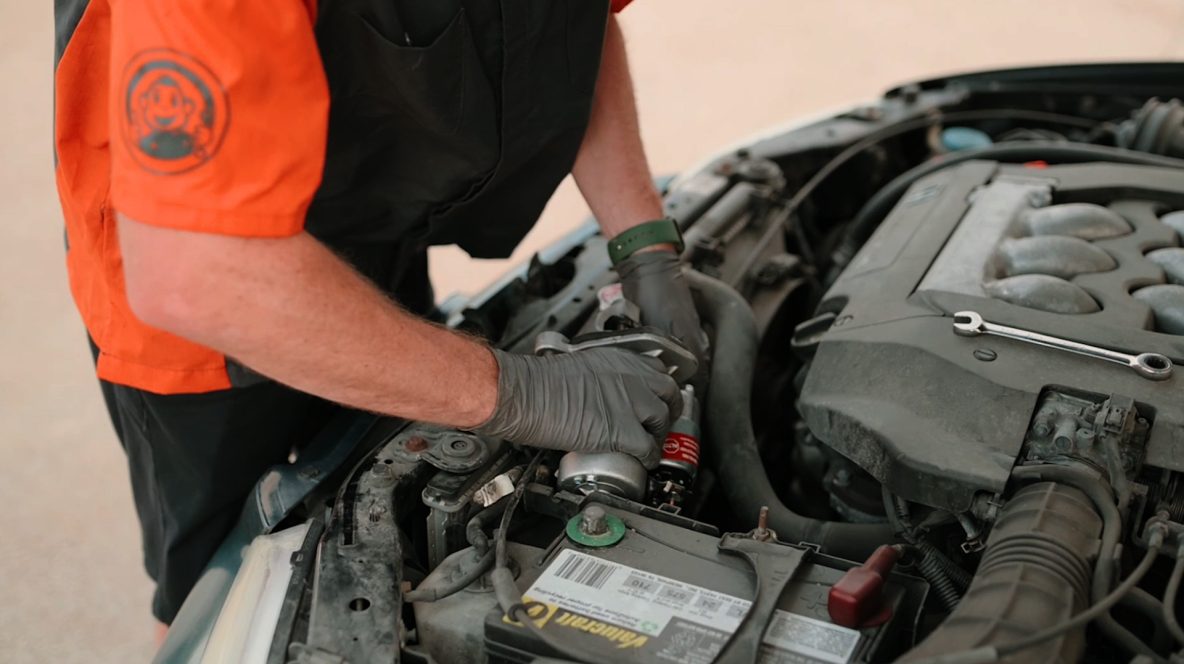
Prevention and maintenance to avoid Starter Motor Troubleshooting Symptoms
Simple checks prevent most starter failures. A small habit saves time and money.
- Keep battery terminals clean. Check them every few months.
- Ensure battery is in good health. Test annually or when the car is older.
- Check cable condition and ground straps. Replace frayed or corroded cables.
- Avoid long cranking. Excessive cranks overheat the starter.
- Insulate starter from heat when possible. Heat shields help in tight engine bays.
- Inspect wiring after towing or collisions. Damage can hide in harnesses.

Related components and common misdiagnoses
Many problems that look like starter failure come from other parts. Check these to avoid wasted replacement.
- Alternator issues
- A bad alternator causes a drained battery. This mimics slow or no cranking.
- Ignition switch faults
- If the switch fails, the starter may not get the signal.
- Fuel or engine mechanical issues
- If the engine locks or is hydrolocked, the starter won’t turn it over.
- Fuse and relay problems
- A blown fuse or bad starter relay can interrupt current flow to the starter.
- Battery age and parasitic drain
- Old batteries or parasitic draws lead to low voltage and starter-like symptoms.
Frequently Asked Questions of Starter Motor Troubleshooting Symptoms
What is the first thing to check when the car won’t start?
Check the battery voltage and the battery terminals. Cleaning and tightening the terminals often fixes the issue.
Can a bad starter drain my battery?
A failing starter can draw extra current, but more often a drained battery is the root cause. Test both to be sure.
Is tapping the starter a safe diagnostic step?
Lightly tapping the starter can help diagnose stuck brushes or solenoid issues. Use care and avoid heavy hits.
How long does a starter usually last?
Starters can last 80,000 to 150,000 miles or longer, depending on use and conditions. Heat, moisture, and repeated short trips shorten life.
Will a slow crank always mean the starter is bad?
Not always. Slow crank often points to low battery voltage, poor connections, or high resistance in cables. Test the battery and wiring first.
Can I drive with a failing starter?
You can drive if the engine is running, but a failing starter risks leaving you stranded. Replace it as soon as possible.
Conclusion
Starter Motor Troubleshooting Symptoms are usually clear once you follow simple checks. Test the battery and connections first, listen for sound clues, and do a voltage test before buying parts. My hands-on work shows most problems trace back to weak batteries or corroded terminals, not the starter itself. Start with the easy fixes, document your tests, and choose repair or replacement based on clear results. If you found this guide helpful, try the steps on your car, share your results in the comments, or subscribe for more practical repair guides.

