

When the temperature drops, a reliable gas heater can make all the difference between comfort and frustration. Carrier is a respected brand in the HVAC world, known for efficient and durable gas heaters. But even the best systems can face problems from time to time. If your Carrier gas heater isn’t working right, you might be dealing with cold rooms, strange noises, or rising energy bills. Tackling these issues quickly helps you stay warm and avoid bigger repair costs.
This article guides you step-by-step through Carrier gas heater troubleshooting. Whether you’re a homeowner, maintenance staff, or a curious DIYer, you’ll find clear instructions and practical tips. We’ll cover common symptoms, essential safety steps, and solutions for both simple and complex problems. By the end, you’ll understand how your system works, why problems happen, and when to call a professional. Let’s make sure your Carrier heater keeps you warm all season.

36% off Today’s Exclusive Deals
Limited-time Exclusive Deals. Check current discount on Amazon.
Check Price on Amazon As an Amazon Associate I earn from qualifying purchases.Understanding Your Carrier Gas Heater
Before troubleshooting, it’s important to know how your Carrier gas heater works. Most Carrier gas heaters use natural gas or propane to heat air, which a blower then distributes throughout your home. Key components include:
- Thermostat: Sets the desired temperature.
- Ignition system: Lights the gas burner.
- Gas valve: Controls gas flow to the burner.
- Heat exchanger: Transfers heat from the burner to the air.
- Blower motor: Circulates warm air.
- Flame sensor: Checks if the burner is lit.
- Control board: The “brain” coordinating operations.
Carrier uses both older pilot light systems and newer electronic ignition systems. Recognizing your heater’s type helps you troubleshoot accurately.
Safety First: What You Must Do
Gas heaters can be dangerous if handled incorrectly. Always follow these safety rules before starting:
- Turn off power: Switch off the heater at the main breaker.
- Shut off gas: Use the shutoff valve near the unit.
- Let the unit cool: Wait at least 20 minutes after use.
- Keep the area ventilated: Open windows or doors.
- Never ignore gas smells: If you smell gas, evacuate and call your gas company immediately.
If you feel unsure at any step, stop and contact a licensed HVAC technician.
Common Symptoms And What They Mean
Carrier gas heaters show several signs when there’s a problem. Here are the most frequent symptoms and what they might indicate:
1. Heater Won’t Start
If nothing happens when you set the thermostat, the causes might include:
- No power: Tripped breaker or blown fuse.
- Thermostat failure: Dead batteries or faulty wiring.
- Safety switch triggered: Access panel not secured.
2. Heater Runs But No Heat
If the blower runs but the air stays cold, possible issues are:
- Ignition failure: Igniter or pilot light problems.
- Closed gas valve: Gas not reaching the burner.
- Dirty burner: Incomplete combustion.
3. Short Cycling (turns On And Off Quickly)
Frequent on/off cycling can mean:
- Dirty air filter: Restricted airflow.
- Thermostat location: Near heat sources or drafts.
- Overheating: Faulty limit switch or blocked vents.
4. Strange Noises
Unusual sounds can point to:
- Squealing: Worn blower belt or motor.
- Booming: Delayed ignition or dirty burner.
- Rattling: Loose panels or screws.
5. Yellow Or Flickering Flame
A healthy burner flame should be steady and mostly blue. Yellow or flickering flames signal:
- Dirty burner: Needs cleaning.
- Ventilation issue: Blocked flue or vent.
- Gas pressure: Incorrect adjustment.
6. Error Codes On Control Board
Newer Carrier heaters have LED indicator lights or display error codes. Consult your manual for meanings, or see the sample table below.
| Error Code | Possible Cause | Action |
|---|---|---|
| 31 | Pressure switch failure | Check venting, replace switch |
| 33 | Limit switch open | Clean filter, check airflow |
| 34 | Ignition failure | Check igniter, gas supply |
| 13 | Limit switch lockout | Reset system, clear obstructions |
Not all models use the same codes. Always check your specific Carrier manual.
Step-by-step Troubleshooting Guide
Let’s look at how to solve the most common Carrier gas heater problems.
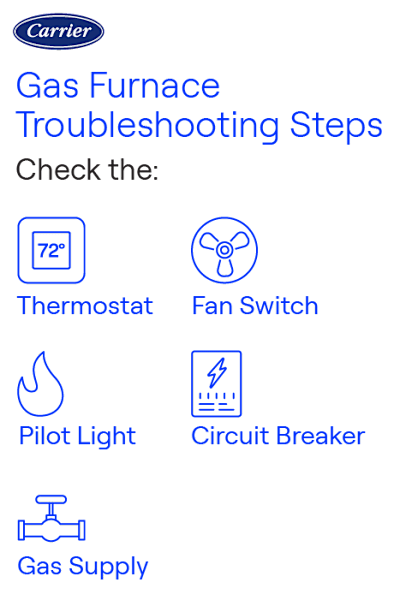
Step 1: Check The Thermostat
- Set the thermostat to “heat” mode.
- Raise the set temperature 5°F above room temperature.
- Replace batteries if the display is blank or unresponsive.
- Make sure wiring is secure (turn off power before checking).
A surprising number of heating issues trace back to a simple thermostat problem.
Step 2: Verify Power And Gas
- Check the circuit breaker. Reset if tripped.
- Inspect the furnace switch (often looks like a light switch nearby).
- Make sure the gas valve is in the “on” position (parallel to pipe).
- Look for blown fuses in the control panel.
If your heater has power but won’t light, move to the next steps.
Step 3: Inspect The Air Filter
A clogged air filter restricts airflow, causing overheating or short cycling.
- Locate the filter (usually behind a panel or in the return air duct).
- Remove and check for dirt or blockage.
- Replace if it looks dirty or hasn’t been changed in 1-3 months.
A clean filter can fix many problems and helps your heater last longer.
Step 4: Examine The Ignition System
Carrier uses several ignition types:
- Standing pilot: Small flame always burning.
- Hot surface igniter: Glows red-hot to light gas.
- Spark igniter: Creates a spark to ignite gas.
If your heater isn’t lighting:
- For pilot lights, relight using the instructions on the unit.
- For hot surface or spark igniters, look for cracks or damage. These parts wear out and can usually be replaced easily.
Never touch a hot igniter—wait for it to cool.
Step 5: Check The Flame Sensor
The flame sensor is a metal rod in front of the burner. If dirty, it can’t detect the flame and will shut off gas.
- Turn off power and gas.
- Remove the sensor (usually one screw).
- Clean gently with steel wool or a dollar bill—never sandpaper.
- Reinstall and restart the unit.
This is a common quick fix for heaters that start then shut off.
Step 6: Inspect Burners And Heat Exchanger
- Look for rust, dust, or debris on burner surfaces.
- Use a vacuum or soft brush to clean gently.
- Check the heat exchanger for cracks or damage—if found, shut down the heater and call a professional. Cracks can leak dangerous carbon monoxide.
Step 7: Examine The Blower Motor
- Listen for squealing or grinding noises.
- Check for loose belts or pulleys.
- Lubricate bearings if the owner’s manual allows (some are sealed).
- Remove obstructions around the blower.
A faulty blower keeps warm air from circulating and can trip safety switches.
Step 8: Check Vents And Exhaust
- Make sure exterior vents are free of leaves, snow, or nests.
- Inspect vent pipes for blockages or disconnects.
- If you see water pooling near the unit, condensation drains may be clogged.
Proper ventilation is key for safety and efficiency.
Step 9: Review Error Codes
If you see a flashing light or digital code, refer to your manual or the sample table above. Codes can tell you if a sensor, switch, or board is at fault.
Step 10: Reset The Heater
- Turn off power at the breaker for 1 minute.
- Turn back on and set thermostat to heat.
- Watch and listen as the heater tries to start. Note any error codes or symptoms.
Many Carrier models will try to restart after a reset and may clear minor faults.
When To Call A Professional
Some heater problems require expert help. Call a licensed HVAC technician if you notice:
- Repeated ignition failures
- Gas leaks or strong odors
- Carbon monoxide alarm sounding
- Cracked heat exchanger
- Electrical burning smells
- Noisy operation that won’t stop
- Error codes that persist after troubleshooting
Don’t risk your safety or void your warranty by forcing repairs you aren’t comfortable with.
Preventive Maintenance Tips
Regular care helps your Carrier gas heater run longer and more efficiently. Here are simple steps you can do:
- Change air filters every 1-3 months.
- Vacuum vents and registers to remove dust.
- Schedule annual professional inspection before winter.
- Keep the area around the heater clear for airflow and safety.
- Test carbon monoxide detectors twice a year.
A small effort now can prevent major breakdowns later.

Advanced Troubleshooting: Control Board And Sensors
If basic steps haven’t worked, the problem may be with control boards, sensors, or wiring. Here’s what to know:
Control Board Diagnosis
The control board manages all safety and operation features. Signs of failure include:
- No response to thermostat
- Flashing or solid error lights
- Random shutdowns
If you suspect the board, check for:
- Burn marks or corrosion
- Loose connectors
- Blown fuses
Most board replacements are best left to professionals, but checking connections can sometimes restore operation.
Pressure Switch And Limit Switch
- Pressure switch: Ensures exhaust gases vent safely. If stuck open or closed, the heater won’t run.
- Limit switch: Shuts off heater if it overheats.
Test with a multimeter for continuity (if you’re comfortable). Replace faulty switches with exact model matches.
Wiring And Connections
Loose, corroded, or broken wires cause many mysterious problems. With power off:
- Inspect all visible wiring.
- Tighten loose terminals.
- Replace damaged wires.
Never bypass safety switches—they prevent fires and gas leaks.
Comparing Carrier Gas Heaters: Common Models And Features
Carrier offers many gas heater models, each with unique features. Here’s a sample comparison:
| Model | AFUE Efficiency | Ignition Type | Common Issues |
|---|---|---|---|
| Comfort™ 80 | 80% | Hot surface | Igniter, filter, blower |
| Infinity® 98 | 98.5% | Electronic | Control board, sensors |
| Performance™ 96 | 96.7% | Hot surface | Condensate drain, flame sensor |
AFUE (Annual Fuel Utilization Efficiency) tells you how much fuel becomes heat. Higher AFUE means better energy savings.
Real-world Example: Diagnosing Short Cycling
Imagine your Carrier heater starts, runs for two minutes, then shuts off. The thermostat is set high, but the house stays cold. Here’s how you might solve it:
- Check the air filter: It’s completely clogged.
- Replace the filter: The heater runs longer, but still shuts off early.
- Inspect vents: One supply vent is blocked by a couch—move it.
- Reset heater: Now it completes a full heating cycle.
Insight: Even a new filter can’t help if vents are blocked. Always check both.
Common Mistakes To Avoid
Many people make these errors during troubleshooting:
- Skipping the air filter: Always check it first.
- Ignoring error codes: They offer direct clues.
- Guessing at repairs: Swapping random parts can make things worse.
- Forcing parts: Forcing igniters or sensors can break them.
- Bypassing safety devices: This is dangerous and voids warranties.
Take your time, follow each step, and always respect safety.
Energy Efficiency And Cost Savings
Keeping your Carrier gas heater in top shape isn’t just about comfort—it saves money too. A clean, well-maintained system:
- Uses 10-25% less energy than a neglected one
- Reduces repair costs by catching issues early
- Extends the life of your furnace by years
According to the US Department of Energy, replacing a dirty filter can cut energy use by 5-15%. That’s real savings every winter.
When To Replace, Not Repair
Sometimes, fixing an old heater isn’t worth it. Consider replacement if:
- The unit is over 15 years old
- Repairs cost more than half the price of a new heater
- Efficiency is under 80% AFUE
- Cracked heat exchanger or repeated breakdowns
New Carrier models offer advanced features like smart thermostats, variable-speed blowers, and ultra-high efficiency. For more on choosing a new system, visit the US Department of Energy.
Quick Reference: Troubleshooting Steps
Here’s a summary of the key steps for fast troubleshooting:
| Step | Action | Result |
|---|---|---|
| Thermostat | Set to heat, check batteries | Ensures correct signal |
| Power/Gas | Check breaker, gas valve | Restores operation |
| Air Filter | Replace if dirty | Improves airflow |
| Ignition | Inspect igniter/pilot | Ensures burner lights |
| Flame Sensor | Clean gently | Prevents shutdowns |
| Vents | Clear obstructions | Safe exhaust flow |
Keep this list handy for quick checks when problems arise.
Frequently Asked Questions
How Often Should I Replace My Carrier Gas Heater’s Air Filter?
For most homes, replace the air filter every 1-3 months. If you have pets, allergies, or live in a dusty area, check it monthly.
Why Does My Carrier Heater Keep Shutting Off Before Reaching The Set Temperature?
This is often caused by short cycling. Check for a dirty air filter, blocked vents, or a thermostat placed near a heat source. If the problem continues, the limit switch or flame sensor may need attention.
What Does A Yellow Flame Mean On My Carrier Gas Heater?
A yellow flame usually means incomplete combustion, often from a dirty burner or blocked vent. Turn off the heater and clean the burner, or call a professional. Never ignore yellow flames—they can signal carbon monoxide risks.
Can I Reset My Carrier Gas Heater Myself?
Yes, you can usually reset your heater by turning off the power at the breaker for 1 minute, then turning it back on. If the heater doesn’t restart or shows the same error, further troubleshooting is needed.
When Should I Call A Professional For Carrier Gas Heater Repair?
Call a licensed technician if you smell gas, hear loud noises, see error codes that don’t clear, or if you suspect a cracked heat exchanger. Regular professional service once a year is also recommended.
Carrier gas heaters are built for reliability, but regular care and smart troubleshooting keep them running at their best. By following these steps and tips, you can solve most common issues, save on energy, and enjoy a warm, safe home all winter.

